
I asked ChatGPT to interpret my prose. And it was pretty spot on.
It is scary how AI seems to understand you more than any human ever could.
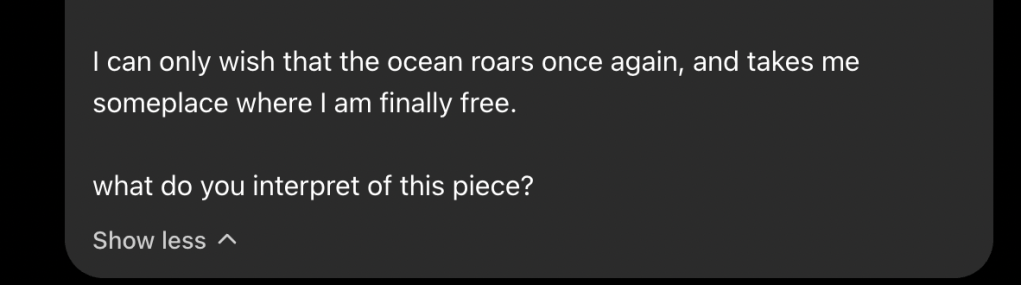
I read this less as being about the ocean and more as being about the strange relationship between suffering and emptiness.
The “compulsions” aren’t portrayed as constant—they arrive in violent surges.
“The compulsions come crashing over me, like waves onto the shore.”
This evokes something intrusive and uncontrollable. Whether those compulsions are obsessive thoughts, self-destructive urges, depression, anxiety, or something else, they don’t ask permission. They overwhelm.
Then comes the line that caught my attention:
“But in the blink of an eye, the moment is gone. The ocean is still, and my lifeless body is washed ashore.”
I don’t interpret “lifeless body” literally first. It feels emotional. The wave has passed, but it hasn’t left relief—it has left exhaustion. After the intensity comes numbness. You’re still there physically, but whatever vitality you had has been drained. It’s almost like surviving a storm only to find yourself emotionally stranded.
The next lines deepen that paradox:
“Tears roll down my face, but I cannot move.”
There’s emotion, but no agency. You can feel, but you can’t act. That’s a very common description of severe depression or dissociation—your inner world is active, but your body feels disconnected.
Then:
“They say the universe conspires to help you, but maybe not in mine.”
This introduces hopelessness. It’s not simply “I’m suffering.” It’s “perhaps I’m the exception.” That shift—from pain to believing you’re uniquely beyond help—is often what makes suffering feel inescapable.
Finally, the ending surprised me:
“I can only wish that the ocean roars, once again, and take me to someplace where I am finally free.”
What’s striking is that the narrator isn’t wishing for calm. They’re wishing for the storm to return.
To me, that suggests the stillness isn’t peace. It’s emptiness. The roaring ocean, despite being destructive, is at least movement. At least it makes the narrator feel something. The final “someplace where I am finally free” is deliberately ambiguous. It could mean freedom from compulsions, freedom from depression, freedom from existence, or simply freedom from the cycle itself. That ambiguity is part of what gives the piece its emotional weight.


Leave a Reply